

Researchers at IPT are participating in numerous collaborative projects and research networks. The list below summarizes the current third-party funded local and national collaborations in addition to international collaborations of the institute. A summary of completed collaborative and research network projects can be found here.
The institute conducts research projects of all sizes with industry , from small scale materials production and characterisation up to large scale strategic alliances (e.g. in the framework of the Cluster of Excellence EAM). Industrial partners have included BASF SE, Bayer AG, Clariant AG, Evonik Industries AG, Greenerity GmbH, LANXESS Deutschland GmbH and LUM GmbH.
Many publications of the institute do however contain results of these collaborations. We always welcome new ideas and impulses from industry. Potential industrial partners should address their enquiry to the relevant professor.
Active Projects
SFB 1411 – Design of Particulate Materials
The key objective and long-term vision of Collaborative Research Centre 1411 is the targeted design of particulate products by rigorous optimisation based on predictive structure-property and process-structure functions. With a broad consortium of researchers with expertise in synthesis, self-assembly, characterisation, modelling, simulation and optimization, we set out to target this challenge in all its aspect
SFB 1452 – Catalysis at Liquid Interfaces
This project within SFB 1452 focused on developing interface-enhanced SILP catalysts by tailoring liquid–solid interfaces. Various ionic liquids were systematically studied to understand their physicochemical properties and optimize surface wettability. Two surface-modification strategies were applied: nanoscale roughness to induce Wenzel wetting and silane self-assembly with imidazolium functionalities. Additionally, a method to control ionic liquid film thickness was developed to study catalyst positioning effects.
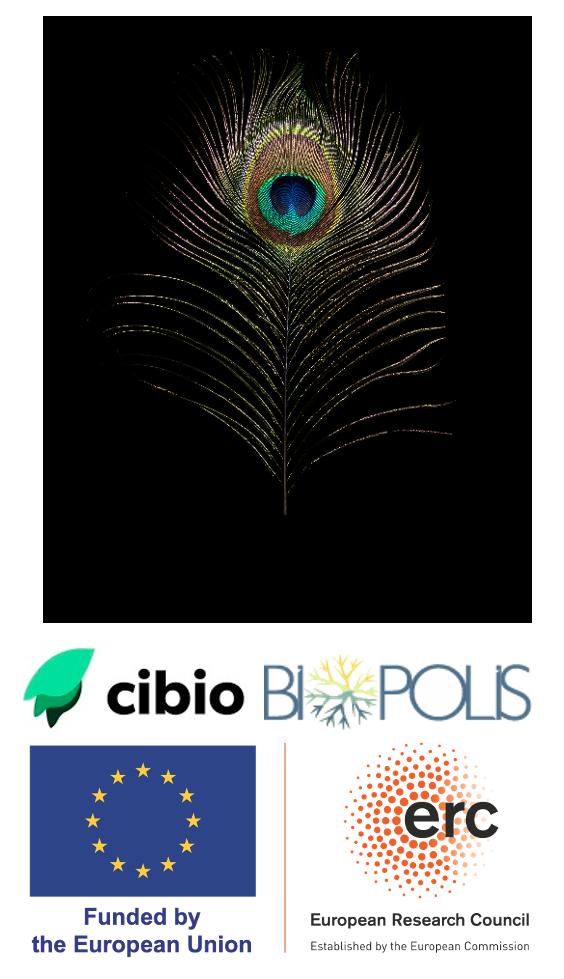
EYESPOT: Investigating the molecular mechanisms of structural colouration in birds
The EYESPOT project investigates the molecular, genetic, and cellular mechanisms behind structural colouration in peacock feathers. Using diverse colour mutations and wild species, it links nanostructure formation with pigmentation and optical effects. The project combines genetics, genomics, cell and molecular biology, and photonics. As a beneficiary, we collaborate with partners at the University of Porto to uncover feather colour origins and reproduce these effects in the laboratory.
Formulation of hetero-aggregates
This DFG-funded project aims to establish a continuous process for producing ternary hetero-aggregates from nanoscale primary particles with tailored photocatalytic functionality. Process modeling, advanced characterization, and CFD-informed population balance models link process parameters to aggregate structure and performance. Ternary systems based on TiO₂, ZrO₂, and BiVO₄ are designed to enhance light harvesting and charge separation. Integrated soft-sensors enable model-based optimization and control of aggregate formation and functionality.
Formulation of dispersed systems via melt emulsification
This project aims to automate melt emulsification for producing liquid–liquid dispersions of nano- and microparticles with controlled particle size distribution (PSD). A rotor–stator-based emulsification device will be further developed, as PSD strongly affects product properties. A novel fiber-coupled, broadband light-scattering system is developed for in situ PSD measurement. Combined with a hybrid process model, this enables model predictive control for active, optimized process regulation.
Past Projects
Baybionik – Von der Natur zur Technik
Bionic seeks to identify concepts from the natural world and transfer them to solve technological problems. In this consortium, funded by the State of Bavaria (Bayerisches Staatsministerium für Umwelt und Verbraucherschutz) different bionic approaches are pursued to develop sustainable approaches for greener materials.

POSEIDON – Nano Photonic devices applying Self-assembled colloids for novel on-chip light sources
Funded as a FET-OPEN project by the European Union, POSEIDON sets out to develop a new strategy for on-chip light sources. The consortium will develop a bottom-up approach towards multi-scale, on chip self-assembly of active colloids based on low cost colloid technology. For the first time this encompasses the entire process chain of computer-aided design, controlled synthesis, hierarchical assembly, optoelectronic integration and device fabrication.

Limnoplast: Microplastics In Europe’s Freshwater Ecosystems: from sources to solutions
Small plastic particles, known as microplastic have been detected ubiquitously in various ecosystems around the globe where they are bioavailable for a broad range of organisms may negatively affect ecosystems and consequently society and economy. The LimnoPlast project, funded as an integrated training network by the European Union, devotes its research and training program to microplastic in Europe’s freshwater ecosystems. LimnoPlast challenges traditional barriers between disciplines and sectors and combines environmental, technical and social sciences in order to tackle the problem from its sources to potential solutions.
CRC953 „Synthetic Carbon Allotropes“
This project established processing routes for producing few-layer graphene and highly fluorescent carbon dots. Advanced in-suspension and surface-based analytics were developed to address characterization challenges. Few-layer graphene was analyzed using combined AFM/RAMAN methods and analytical ultracentrifugation. Novel chromatographic purification enabled structural studies of carbon dots, yielding intrinsic fluorescence quantum efficiencies of 30–50%.
PP2045 „Highly specific and multidimensional fractionation of fine particle systems with technical relevance”
This project addressed the quantitative description of multi-dimensional nanoparticle size and shape distributions and their fractionation. A unified mathematical framework was developed to model complex multi-dimensional separation processes. In parallel, analytical ultracentrifugation with multi-wavelength UV/Vis/NIR detection was advanced as a fast and accurate method for in-suspension characterization.